
Tech Neck Relief: How Massage Therapy Helps Desk Workers and Screen Fatigue
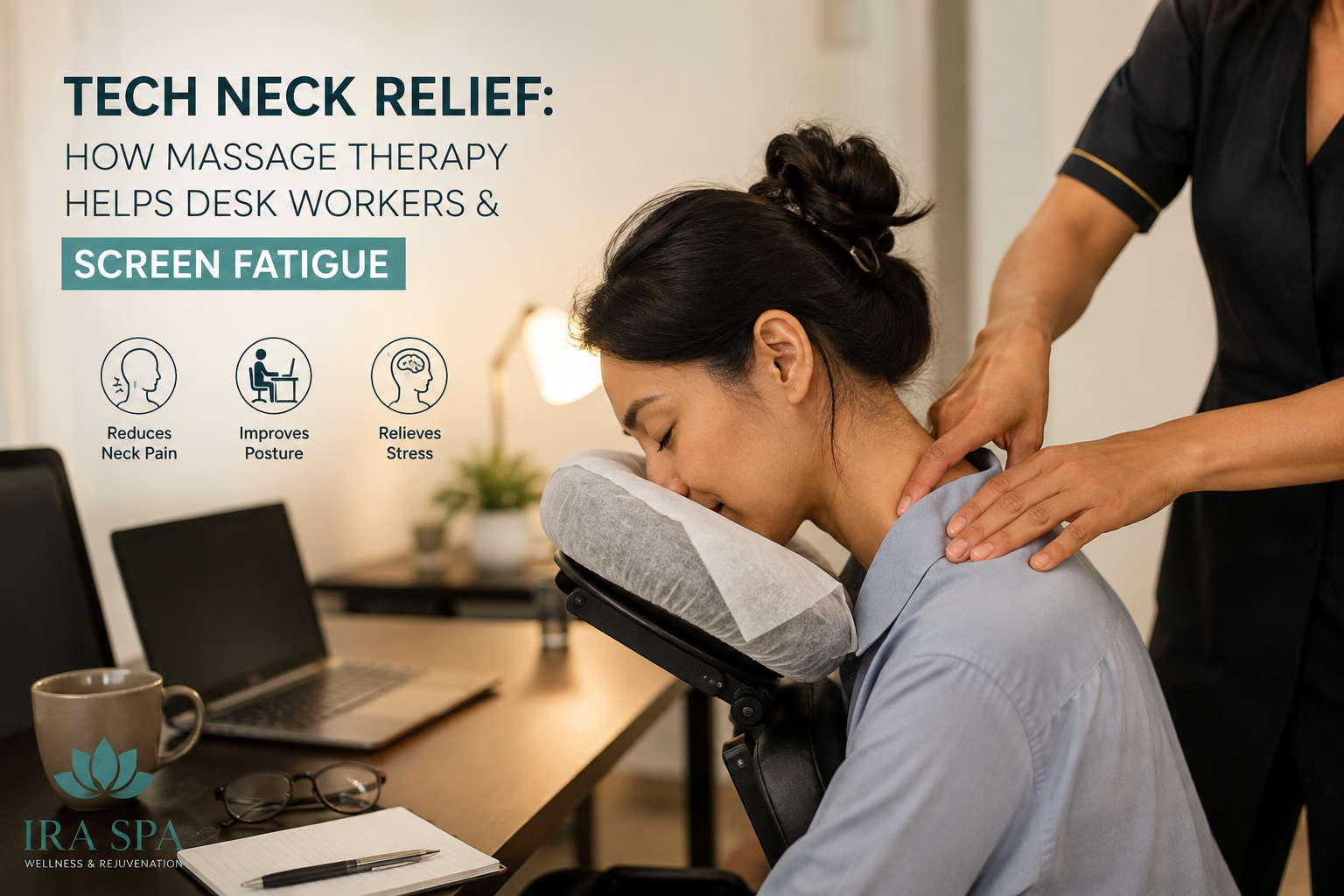
Tech Neck Relief
If your neck feels like it’s carrying a bowling ball by 6 PM, you’re not imagining it. Indians now spend close to 7 hours and 47 minutes a day on screens — among the highest averages in the world, driven by long work hours on laptops followed by even more time on phones after logging off. For anyone with a desk job in Mangalore, Kalaburagi, or any of India’s busy IT and business hubs, that adds up to a neck, shoulder, and upper back that rarely get a break.
Doctors have a name for the pattern of stiffness, headaches, and postural strain this causes: tech neck. It isn’t a diagnosis you’ll find in old textbooks, but it’s real, it’s common, and it’s very treatable — especially with the right kind of massage therapy.
What Exactly Is Tech Neck?
Tech neck describes the cumulative strain that builds up when your head spends hours tilted forward toward a screen — a laptop, a phone, or a monitor set too low. The human head weighs roughly 4.5–5.5 kg in a neutral position, but every inch it tips forward multiplies the load your neck muscles have to support. At a 45-degree forward tilt, the effective strain on the cervical spine can rise to the equivalent of nearly 20 kg — a weight your neck was never designed to hold for eight hours a day.
The muscles most affected are the ones IRA Spa therapists work on constantly: the trapezius, levator scapulae, and the small suboccipital muscles at the base of the skull. When these stay contracted for hours without release, they develop trigger points — tight, tender knots that radiate pain into the shoulders, upper back, and even the head.
The Numbers Behind the Problem
This isn’t a minor discomfort a handful of people deal with. Research on Indian IT professionals paints a clear picture:
- A study of computer office workers across major Indian IT hubs found that 38.2% reported a year of upper-body pain, with neck pain, lower back pain, and eye strain topping the list of complaints.
- Long working hours, excessive smartphone use, poor posture, and incorrectly adjusted workstations were identified as the primary risk factors.
- Separately, research on desk-based office workers in India found that computer use beyond 4–6 hours a day was the single strongest predictor of work-related neck pain.
- Globally, neck pain is now recognised as more common among office workers than in almost any other occupation, with annual prevalence estimates ranging from 42% to 63%.
None of this is surprising once you consider how the modern workday is structured — back-to-back video calls, hunched shoulders while typing, a phone cradled between ear and shoulder, and barely a proper break between sign-in and sign-off.
The shift toward hybrid and remote work has, if anything, made this worse rather than better. A proper office chair and monitor stand often got swapped for a dining chair and a laptop propped on a stack of books, and commute time that once forced a break between “work mode” and “home mode” simply disappeared. Add in the after-hours scrolling that follows a full workday, and the neck barely gets a chance to reset before the next round of screen time begins.
Book Your Appointment
Why Screen Fatigue Is More Than Just Tired Eyes
Tech neck rarely travels alone. It typically shows up alongside:
- Tension headaches that start at the base of the skull and wrap around the temples
- Eye strain and blurred focus from sustained close-range screen viewing
- Rounded shoulders and a forward head posture that persists even away from the desk
- Reduced range of motion, making it uncomfortable to turn the head fully while driving or checking blind spots
- Fatigue and poor concentration, since the body spends energy compensating for the postural imbalance
This is exactly why a purely visual fix — like adjusting monitor height — helps but rarely resolves things on its own. The muscles have already tightened, and tight muscle tissue needs hands-on release, not just better habits going forward.
How Massage Therapy Breaks the Cycle
Massage works on tech neck through a few distinct mechanisms, and understanding them helps explain why it’s more effective than stretching alone for people whose pain has already set in.
It releases muscular trigger points. Focused pressure on the trapezius, levator scapulae, and suboccipital region breaks up the tight knots that build from sustained poor posture, restoring blood flow to tissue that’s been starved of it for hours.
It improves circulation to fatigued muscles. Better blood flow clears out metabolic waste products that accumulate in overworked tissue and delivers oxygen and nutrients that support recovery.
It calms the nervous system. Chronic screen-related stress keeps the body in a low-grade “on” state. Massage lowers cortisol and shifts the body toward the parasympathetic (rest-and-digest) state, which is part of why a session leaves you feeling mentally clearer, not just physically looser.
It restores range of motion. Consistent bodywork gradually lengthens shortened muscles and loosens the fascia around the neck and shoulders, making it easier to hold a neutral posture through the next workday rather than sliding straight back into the same slouch.
Which IRA Spa Treatment Fits Your Tech Neck?
Not every desk worker needs the same session. Here’s how to think about it depending on how your day usually goes and how long the tension has been building.
For a quick reset between meetings or after a long WFH stretch, a focused Head, Neck & Shoulder session is built exactly for this. It targets the trapezius and suboccipital muscles directly, and at just 30 minutes, it fits into a lunch break without derailing the rest of your day — similar in spirit to the short, targeted sessions covered in our guide to quick massage treatments for busy schedules.
For chronic, deep-set tension that hasn’t responded to quick fixes, Deep Tissue Therapy goes further into the muscle layers, using slow, deliberate pressure to break up the adhesions that form when neck and shoulder stiffness has been left untreated for weeks or months — a pattern IRA Spa sees often among desk workers and long-hours professionals.
For posture correction alongside relaxation, Balinese Therapy combines massage technique with acupressure and stretching, which is particularly useful for the rounded-shoulder, forward-head posture that tech neck creates over time.
If your tension has spread across your whole upper body — not just the neck but shoulders, mid-back, and even lower back from prolonged sitting — a Full Body Massage covers the entire chain of muscles that compensate for poor desk posture, rather than isolating just one tight spot.
For screen-related eye strain and headaches specifically, a traditional Champi head massage works on pressure points that ease sinus congestion, tension headaches, and the mental fog that comes from hours of close-focus screen work.
Small Habits That Make the Relief Last Longer
Massage therapy resets the tension, but a few habits between sessions help you hold onto that relief:
- Follow the 20-20-20 rule — every 20 minutes, look at something 20 feet away for 20 seconds to rest both your eyes and your neck’s fixed position.
- Raise your screen to eye level so you’re looking straight ahead rather than tilting down, whether you’re on a laptop or a monitor.
- Stand and move every hour, even if it’s just a two-minute walk to refill water — sustained stillness is often worse for the neck than the screen itself.
- Book regular sessions rather than waiting for a flare-up. Just as regular spa visits support long-term wellbeing, consistent bodywork prevents tension from compounding week over week rather than only treating it once it’s already painful.
- Set a reminder to check your posture, especially during long calls. It’s easy to lose track of a slumped neck and rounded shoulders once you’re focused on a screen, and a simple hourly nudge can be enough to catch it before it settles in.
Conclusion
Tech neck isn’t going away as long as remote work, hybrid schedules, and screen-heavy jobs remain the norm across India’s workforce. But the strain it causes doesn’t have to become a permanent part of your day. Whether it’s a focused 30-minute Head, Neck & Shoulder session between calls or a longer Deep Tissue or Balinese therapy to undo weeks of accumulated tension, the right massage — done consistently — can genuinely change how your body holds up against a screen-heavy routine. It’s also worth pairing physical relief with a mental reset; how spa treatments support mental wellness and emotional healing is worth a read if screen fatigue has been weighing on more than just your neck.
If your shoulders have been creeping up toward your ears by mid-afternoon, don’t wait for it to turn into a chronic issue. Explore more wellness reads on the IRA Spa journal, or go ahead and book your appointment at our Kodialbail, Mangalore or Kalaburagi location today.
Book Your Appointment
Ready to feel the difference?
Bring this ritual to life at Ira Spa, Mangalore or Kalaburagi.
Book an AppointmentRelated Reading

Salt Scrub vs Sugar Scrub: Choosing the Right Body Exfoliation
Salt Scrub vs Sugar Scrub Walk into any wellness store in Mangalore and you'll find shelves lined with body scrubs promising the same thing: smoother, brighter, more even-toned skin. Most of them boil down to one of two base ingredients — salt or sugar. They look similar in a jar, but they behave very differently […]

Monsoon Skin Care: Spa Treatments for Humidity-Damaged Skin in Coastal Karnataka
Monsoon Skin Care The first monsoon downpour over Mangalore feels like a gift after months of coastal heat. Streets cool down, the air smells like wet earth, and everyone breathes a little easier. Your skin, though, rarely gets the memo. While the temperature drops, humidity along the Dakshina Kannada coast regularly climbs above 85 – […]

Couples Spa Day: What to Expect When You Book Together
Some of the best conversations happen in the quiet after a massage, not during dinner or on a drive somewhere. That's part of why couples spa days have become one of the most requested experiences at wellness centers across India — they give two people a shared window to slow down without a screen, a […]